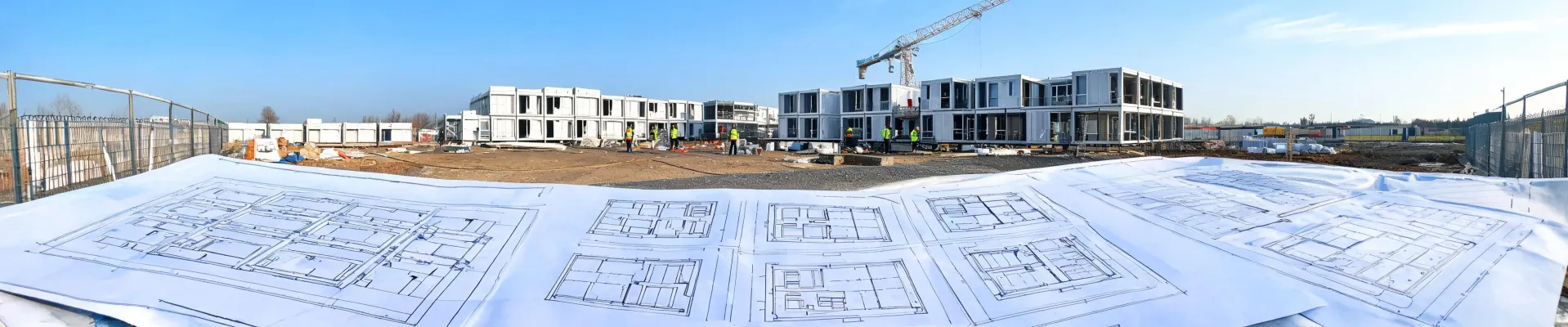
What I thought the problem was
In August 2022, I placed an order for a (6 bay) euro modular building for a construction site welfare unit. I'd been handling modular and temporary building orders for about five years at that point. I thought I knew the game: collect quotes, compare specs, pick the cheapest option that meets requirements, sign, wait.
That's how most of us are trained. The spreadsheet says the budget option is 15% cheaper with "comparable" specs. The spreadsheet must be right.
My gut said something was off. The bay dimensions on the cheapest quote didn't quite line up with our site plan — close, but not quite. I overrode it. The numbers were clear, the timeline was tight, and re-checking would've added another week to the decision. I went with the spreadsheet.
Eight weeks later, the building arrived. It didn't fit. The configuration was "technically 6-bay" but the wall panel tolerances meant our planned connection to an adjacent temporary office didn't work. $12,000 to rework the electricals and modify the connection point. Then the second unit — supposedly "in stock" — slipped another three weeks because that "stock" was actually an unconfirmed production slot.
Total damage: $47,000 over budget and six weeks behind schedule. Not because the vendor lied. Because I thought I was buying a commodity. I wasn't.
What the actual problem was
Mistake 1: I treated modular buildings like they're standardized
Here's what nobody tells you when you first start sourcing 3D modular buildings or Euro modular units: "standard" is a marketing word. Every manufacturer defines bay dimensions, panel thickness, electrical routing, and connection points slightly differently. Two units that both call themselves "(6 bay) euro modular" can be incompatible at the joint.
From the outside, it looks like you're comparing identical products at different prices. The reality is you're comparing three different products that all describe themselves the same way.
That's the surface illusion. The spec sheets look comparable. The actual configurations aren't.
Mistake 2: I confused "available" with "matched"
When I chose the budget quote, I asked the right question: "Do you have the 6-bay configuration in stock?" They said yes. What I should have asked: "Do you have a unit that matches our exact site layout, electrical spec, and connection requirements, in stock, with a guaranteed delivery window?"
That's a very different question. And it's why supplier matching matters more than price comparison.
Later, on a different project, we used McGrath RentCorp's supplier matching process. The difference wasn't magic — it was that their team asked for our site plan, electrical schedule, and adjacent structure specs before quoting anything. They came back with two options instead of eight, and both actually fit. One had a confirmed delivery date, the other had a "likely" window. We paid about 8% more for the confirmed one. Worth every penny.
I'm not saying that's the only way to do it. I'm saying that if you're comparing quotes without confirming that each vendor is quoting against the same physical constraints, you're comparing noise.
Mistake 3: I simplified the temporary house vs modular building decision into a price question
If you've spent any time researching temporary house vs modular building options, you've probably noticed that most comparison articles focus on cost per square meter. Useful, but it's not the decision driver when you're on a deadline.
The variables that actually determine whether your project stays on schedule are: permit lead time, transport route clearance, foundation preparation, crane scheduling, and utility connection windows. None of those show up in a unit-price comparison. All of them affect delivery certainty.
It's tempting to think you can just compare the bottom-line numbers. But when your project depends on the building arriving by a specific date, the cheapest quote is often the one with the most uncertainty baked into it.
What it actually cost
Let me break it down from our project cost report, because "we lost $47,000" sounds abstract until you see where it goes:
- $12,000 — retrofitting electrical connections and modifying the bay connection to fit the adjacent temporary office. The "standard" configurations didn't align.
- $8,500 — emergency transport for a replacement unit when the original vendor's production slot slipped. We needed the unit on site within five days. Not a discount price.
- $26,500 — extended site overhead and a penalty clause triggered by the six-week delay.
The original price difference between the lowest and second-lowest quotes was $9,000. The delay cost almost three times that.
The $26,500 line item changed how I think about procurement budgets. We'd allocated for the building itself. We hadn't allocated for the six weeks of site overhead that came from the delay. That's not a line item most modular building quotes account for — because it's not the vendor's cost. It's yours.
And that's before counting the two weeks my team spent firefighting instead of doing their actual jobs, plus a very uncomfortable call with the project manager who'd been promised a move-in date.
What I do differently now
I'm not going to pretend I have a perfect system. I don't. But I do have a checklist, and it's saved us from at least three repeat mistakes in the past 18 months.
First: I stopped treating "in stock" as a yes/no question. Now I ask for the specific unit ID, the confirmed delivery window, and whether the delivery date is guaranteed or estimated. If it's estimated, I assume it slips.
Second: supplier matching comes before price comparison. I want to know that the vendor has actually handled a comparable configuration before, not just that they can theoretically produce one. Services like McGrath RentCorp sourcing exist because this step is genuinely hard to do well on your own.
Third: I budget for time certainty. On a project with a hard deadline, I'll pay 8-12% more for a guaranteed delivery window. The alternative — a "probably on time" promise at a lower price — is a bet I've lost before. In March 2024, we paid $3,200 extra to lock in a delivery date for a temporary classroom unit. The event it was supporting had a $40,000 cancellation penalty if the space wasn't ready. That's not a hard math problem.
The checklist we use now has six items:
- Confirm the exact configuration against the site plan — not the catalog description.
- Confirm whether the delivery window is guaranteed or estimated.
- Confirm who handles transport, crane, and installation.
- Confirm permit responsibility and lead time in your jurisdiction.
- Confirm payment milestones are tied to delivery milestones, not calendar dates.
- Confirm there's a named human on the vendor side who owns your order, not just a sales inbox.
This won't eliminate every problem. I can only speak to modular building procurement in the markets we operate in — if you're dealing with cross-border logistics or unusual code requirements, there are probably factors I haven't encountered. Your mileage may vary.
But if you're about to sign a quote because it's the cheapest one on the sheet, and your project has a fixed start date, do yourself a favor: call the vendor and ask what "in stock" actually means. The answer might change your decision.